Learning from the Herbert F. Johnson Museum of Art


As a History of Art major in the College of Arts & Sciences, one of my favorite parts of my classes is getting to step beyond the classroom and into the I. M. Pei-designed Johnson Museum. There’s something almost magical about encountering artworks face-to-face, especially when they’re the same images you’ve only known from slides in class! Standing in front of centuries-old artworks, it’s easy to imagine how inspiring it would be for any student to see history “come alive” in the Museum.
Sometimes, our assignments take us straight into the Johnson’s vast permanent collection and temporary exhibitions. As part of one of my courses, ARTH 2400: Introduction to Early Modern Art: Cosmopolitanism and Empire, taught by Professor Ana Howie, I went on a scavenger hunt with two of my friends, searching the galleries and taking photographs of artworks connected to our class themes.
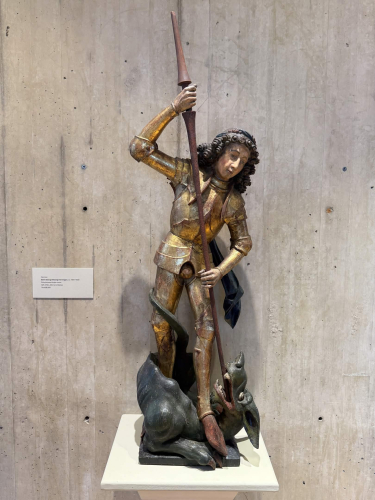
For the same course, we each selected a work from the Museum’s second floor, which focuses primarily on classical and pre-1800 European art, to write a catalogue entry essay on. The sculpture I selected, Saint George Slaying the Dragon (c. 1450–1500), has the slightly dazed expression of a Cornellian deep in finals season—determined but maybe more than a little sleep-deprived.
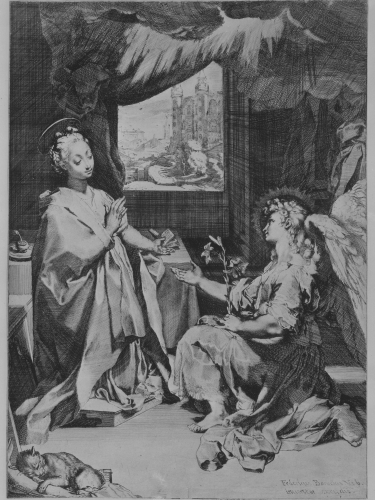
More recently, in ARTH 4462: Early Modern Illuminations: Light, Sight, and the Visual World in Europe, 1400–1700, our seminar often met in the Johnson’s study galleries, smaller spaces designed for close examination of works. There, museum staff—Drs. Andrew Weislogel and Jakub Koguciuk—curated selections of pieces that directly supported our weekly discussions. My favorite was Federico Barocci’s The Annunciation (c. 1585), with its incredible use of line (or the lack thereof) to convey shadows and light. But perhaps the best part of the piece is the adorable sleeping cat tucked into the bottom left corner!
Experiences like these remind me how fortunate we are to have a museum woven into our coursework. From scavenger hunts in the permanent collection to close analysis in the study galleries, Cornell allows me to engage with art history in ways that go beyond lectures. Here, the History of Art major feels less like a subject I study and more like something I live through firsthand.